

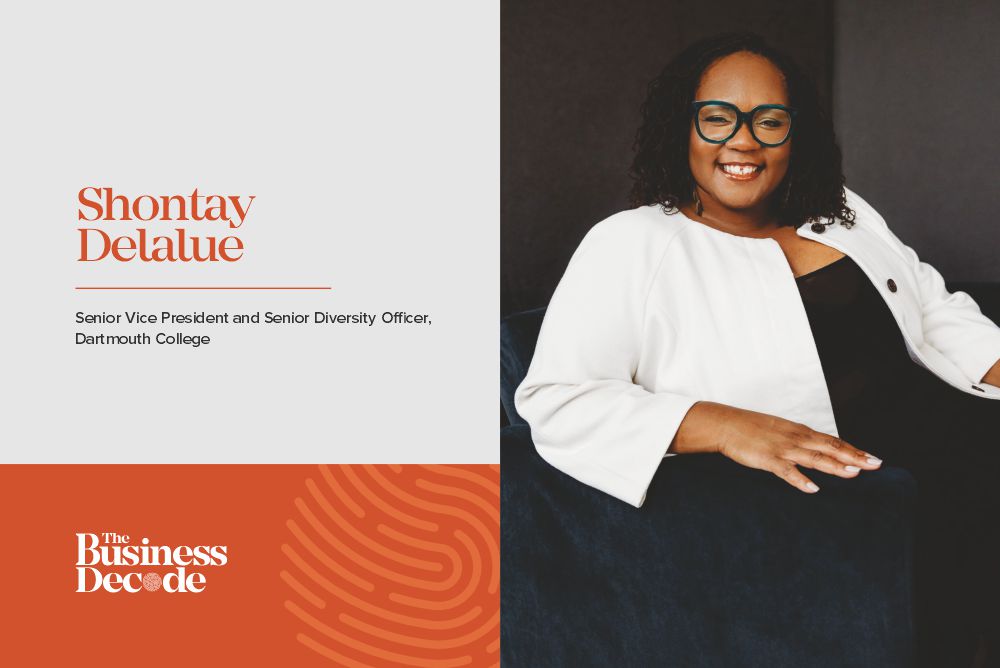
Shontay Delalue, PhD, is the Senior Vice President and Senior Diversity Officer at Dartmouth College. She is responsible for implementing and evaluating diversity, equity, and inclusion (DEI) efforts across the institution. Over the years, she has built an impressive reputation in the field of DEI and global relations. Prior to joining Dartmouth, Shontay held administrative roles at Brown University—both as the Assistant Provost for Global Engagement, building the infrastructure of support for the over 1,500 international students and later as the Vice President for Institutional Equity and Diversity, overseeing the $165 million DEI strategy plan.
Dr. Delalue describes her leadership philosophy as coming from a place of cultural humility. “We engage in multicultural encounters on a daily basis,” she says. “But we all have limits to our own knowledge; therefore, it is important to continuously engage in critical reflexivity and participate in the type of work that will bring about positive change.”
Shontay’s career in education has spanned more than two decades in a variety of academic settings, including state colleges, a high school, a business school, and two Ivy League institutions. She has held various positions as well, from director of admission, wellness counselor, and advising dean to assistant provost, vice president, and her current role as senior vice president. Since 2004, she also has maintained teaching alongside her administrative duties.
She currently leads Dartmouth’s strategic process to increase diversity and achieve equity. In 2022, the Institutional Diversity and Equity (IDE) division she oversees introduced a three-year DEI plan called “Toward Equity,” to unify the institution’s efforts. In addition to her administrative role at Dartmouth, she teaches in the residential Master of Public Health Program at the Geisel School of Medicine. Nationally, she was recently appointed as a research fellow with the TIAA Institute. Shontay has been encouraged to lead an institution someday and feels “uniquely positioned” to do so with humility and integrity because of the breadth and depth of her experiences.
The DEI leader finds inspiration in the countless handwritten thank-you notes she has received over the years. “It is an honor to be recognized by peers,” says Delalue, “but it is quite moving to receive a note from a student, staff, or faculty member stating that my words and actions had a positive impact on their life.”
Taking on a Role in the DEI Space
Shontay has always been a staunch advocate for DEI initiatives, but she was initially reluctant to accept the role of Chief Diversity Officer (CDO). However, she points out that her work in this space actually dates to her undergraduate days. “Over the course of my educational and professional career, while I saw the field evolve, I also saw the mistreatment of countless practitioners, mostly Black women,” she says, noting that DEI practitioners were allocated small budgets, subpar spaces on campus, and no staff for support. “So, I said to myself early in my career, ‘I will always center DEI in my work but I never want the head job.’”
After accepting her first CDO position, she realized that the old adage, never say never, is true! “Once I had a chance to fully process what I could do in a role like this, given my experience and the sacrifices made by women before me, I felt ready for the role,” she adds. “I have been serving in senior-level DEI positions ever since.”
Shontay’s journey in the DEI space has not been an easy one. As a first-generation college graduate from a low-income background, she has encountered multiple roadblocks on her educational and professional journey. Often, in certain spaces, she found that she was the only one of her race and/or gender. Instead of allowing that to dampen her spirits, she made sure to learn valuable lessons and center radical joy. Shontay points out that being the sole woman or the sole Black person in the room can feel lonely at times, but by being there at the table, she can give voice to perspectives and experiences that would otherwise not be centered.
“I have embraced my calling and recognize that not everyone can live where I have lived and touch the lives I was intended to touch,” she adds. “My fortitude to be a pioneer and chart new territory is a gift.”
Shontay entered the higher education field as an Admission Counselor at the University of Maine, her alma mater. In her first position out of college, she made $25k and got to travel home (NJ/NYC) for her recruitment territory. “I had a phenomenal first supervisor, Jon Henry, and that experience kickstarted my career trajectory,” she recalls. After a few years in her first role, she ventured out to Juneau, Alaska, where she worked at the University of Alaska Southeast – an institution that she still holds fond memories of after departing almost 20 years ago.
She has a bachelor’s degree in Communication and a Master of Education – both from the University of Maine. She attended the Harvard University Graduate School of Education’s Institute for Management and Leadership in Education and earned a Ph.D. in Education through a joint program of the University of Rhode Island and Rhode Island College, where her doctoral work utilized critical race theory to explore the racialized experiences of African and Caribbean international students in the U.S. She is a member of Delta Sigma Theta Sorority, Inc. and serves on several boards and councils.
Working at Dartmouth College
Dartmouth College, founded in 1769, is nestled in the White Mountains of New Hampshire. A member of the Ivy League, it educates some of the world’s most promising students and prepares them for a lifetime of learning and responsible leadership through a faculty dedicated to teaching and the creation of knowledge. In addition to the undergraduate college, Dartmouth has a graduate school, a medical school, an engineering school, and the oldest business school in the country.
Shontay points out that Dartmouth’s original charter was to educate Native youth – a fact not known to many people. While the charter was not being honored for two centuries, about 200 years after its founding in 1972, the then-president recommitted the institution to its original charter, and a robust effort to recruit and retain Native American students unfolded. Shontay was honored to join the institution at a pivotal moment when it was celebrating 50 years of co-education and a recommitment to the original charter.
In July of 2021, Shontay accepted an appointment as Dartmouth’s inaugural Senior Vice President and Senior Diversity Officer (SDO) to oversee the division of IDE. She reports to the President and serves as a senior strategist partnering with other senior colleagues to advance the institution. In addition to her focus on strategy planning, service, and execution, she also partners with other senior leaders to respond to real-time situations that can impact the campus community—for example, campus incidents or national and international crises.
Understanding the demanding nature of DEI work, she keeps her team motivated by encouraging professional development and holding transparent staff meetings. “Our annual retreats are an opportunity to recharge as a team and collectively realign around a shared mission and vision.”
Creating and Maintaining Balance
Shontay describes executive-level leadership as a role that demands a lot of time. This is in addition to being a wife, mother of two (a 19-year-old daughter and an 8-year-old son), and an involved national leader. A regular day at work involves meetings with faculty, staff, students, administrators, alumni, and donors. In addition to that, she focuses on strategy planning, chairing committees and other forms of service, responding to countless emails, and hosting groups at her home for receptions and dinners to build community.
Given the many demands on her time and the intimate nature of her community-centered work, Shontay says that she has had to learn to be intentional about holding space for her personal priorities as well. Shontay maintains her work-life integration by scheduling time for herself and with her family – a strategy she learned from a former colleague. His rationale, she explains, was that his mind was trained not to miss a meeting with his boss or a colleague when it was on his calendar; so, by adding his meetings with himself to the calendar (even on the weekend), he was able to maintain that same commitment. “I have used that strategy, and it works,” Delalue says.
DEI Is Central To – Not Separate From – Academic Excellence
Shontay has been doing stellar work in the DEI space – and redefining the profession along the way by bridging theory and practice in tackling some of the most pressing issues of our time.
For institutions to be academically excellent, they must be diverse because the most innovative ideas are born when people from different backgrounds work together on a problem, Shontay points out, adding that there is research to prove this. She also says that DEI is not a separate task list that needs to be checked off. One must ensure that DEI practices are embedded into the campus culture, student mental health supports, the sustainability plan, curriculum, policies and even ground maintenance.
“I am personally combining my administrative responsibilities with my research and exploring through a DEI lens what the role of higher education should be in combatting the persistent health disparities and wealth inequities in this country – particularly in the Black community,” Shontay says. In her administrative role she mentions supporting all people – those who represent different religions, genders, sexual orientations, races, nationalities, abilities, political views, veteran statuses and so on. Her research focuses on the Black community because when looking at data on education, health, and wealth, that community has some of the worst outcomes due to systemic inequities that have a particular impact on that group.
The Definition of Success
Shontay’s professional journey has brought her to a position that allows her to make a difference at the institutional level. And she continues to strive for success; however, she does not define success in terms of individual achievements. For Shontay, success comes from both short- and long-term endeavors.
In the short term, she says, effective DEI work is marked by a compelling strategy which lays out a set of measurable actions to be accomplished within a specified time frame. “There is an accountability matrix with a well-thought-out plan, and success is determined by well-timed measurement of both the goals and the campus climate,” she adds.
As Shontay has progressed in her career, she also has come to understand the value of the long-term strategy. For her, success also means being on the right side of history. “This means that the approach I recommend may not be popular at the time,” she explains. “But if it moves the institution in a way that centers diverse experiences, in 20 or 30 years, alumni will be able to look back on that time fondly and feel proud that their institution was at the forefront of positive change.”
Advice to Aspiring DEI Leaders
Shontay advises aspiring DEI leaders not to embark on a solo expedition to bring change. “Position yourself as a thought partner and consultant with the expertise to assist your institution,” she says, “and team up with your senior colleagues to do this work together.” She recognizes the work can feel daunting at times, but she encourages each person to find the things that bring them joy so they can feel restored and continue to do the good and necessary work.