

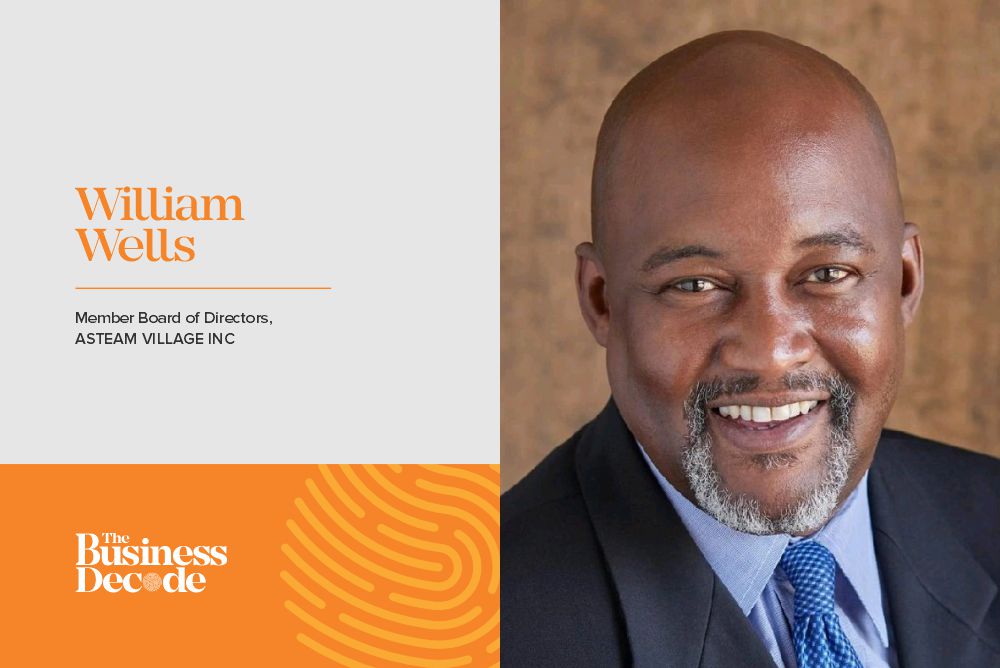
Disruption to create a better world does not happen in a vacuum. It demands a visionary leader who is committed to the cause and has a penchant for innovative problem-solving, community engagement, and empowering others. William Wells, Founder and Executive Director at aSTEAM Village, is such a leader. He is dedicated to disrupting poverty through innovative STEM education and workforce development programs.
William’s efforts have put thousands of students on the path to professional growth and success.
For him, his greatest achievement is witnessing the flourishing of the first cohort of students who came to him a decade ago as fifth and sixth graders. “One of the most rewarding moments,” William shares, “is when a mother approaches him at work and says, ‘My son is out in San Diego serving the Navy’.” Or, when he hears others say, “Those three years in your program lit a fire in them and pointed them in the direction they are going.”
One of the reasons for William’s success is his thirst for learning. He considers himself a lifelong student who continues to learn. “I want to learn,” he says. “That’s why I’m so blessed.
What Is Success?
William considers it a success when a parent or student returns and says that their time with them and in their program produced a specific result. This result is usually entry into college, the workforce, or acceptance into the military. According to William, it is about students being able to enter these paths knowing what they want to do, doing it on their own terms, and charting their own pathway. “That is ultimately what I define as success,” he adds.
He also shares that they often don’t see these successes firsthand. It is only occasionally that somebody actually comes up to them later in life and says, “Hey, thank you. Being in your program and working with you helped me get to where I am today.”
William’s definition of success has changed over the years. When he was younger, he defined it based on what people told him and recognized him for. As he matured, he realized that real success isn’t about awards and recognition, but rather the impact and outcomes of his work. “True successes are witnessing the outcomes and impact on both young and old participants in our programs,” William says. One prime example of that is Anthony Gant, who is currently one of the board members of aSTEAM.
He was one of the students in the first cohort and stayed in aSTEAM Village’s program from 5th to 12th grade. After graduating from high school, he left Kansas City with $30,000 in scholarship money and went on to attend Arizona State University. Anthony graduated on time in four years while raising a baby girl. Three weeks after college, he was hired by U-Haul International, where he is now in charge of converting their vehicles from gas to electric. “Today, he serves on our board as well,” William points out. “This is success for me.”
Emergence of an Entrepreneur after a Layoff
William always had an entrepreneurial mindset, but it was an unfortunate layoff that pushed him onto the path of entrepreneurship.
In 1999, he was working for a competitive local exchange carrier, reselling phone lines as part of the telecom deregulation—an area that still influences aSTEAM Village through its community broadband initiatives. His career took a turn when a knee injury led to his dismissal from the company just before his scheduled surgery. “My income plummeted from $75,000 a year to $375 a week on workers’ compensation,” William recalls.
During his year-long recovery, he made a pivotal decision, which shaped his new professional journey. “I decided never to return to corporate America,” William shares. “I used that rehabilitation period to position myself to start a telecommunications company.” While building his company, he recognized a critical gap in the field: the lack of talent and skilled labor. This led him to turn the company into a STEM education program
“That journey ultimately led me to found aSTEAM Village,” William says. “It shaped our mission, scope of work, and the global outcomes we strive to achieve as an organization.”
About aSTEAM Village
aSTEAM Village is focused on driving innovation, workforce development, community development, and economic development in a digital world through STEM and STEAM education for a future where every child, adult, and family, can thrive and reach their full potential.
The organization has come a long way since its foundation a decade ago – it celebrated its 10th anniversary in February of 2024. William points out that they started out in 2014 as a straightforward K-12 STEM education program because that was the foundation they needed to build upon. As aSTEAM Village began to mature and grow and its first six cohorts of students grew older, it moved into workforce training, workforce development, and industry certification space.
William explains that they wanted students who came through their program to have industry-recognized certifications before they got their high school diploma. He and his team believed that this would set them up for success in a digital world that’s fueled by the global economy.
aSTEAM Village’s evolution reflects its mission: to disrupt poverty through education, workforce development, and STEM and STEAM education. “That’s pretty much what we’ve been doing,” William says. “And, now we’re at a point where we’re making some structural changes.”
Many of aSTEAM Village’s students are now engaged in paid professional projects, which is helping disrupt poverty. As a result, William and his team are separating some of these professional services away from the organization’s core operations. This allows aSTEAM Village to maintain its focus on K-12 STEM education and workforce development, according to William.
aSTEAM Village has experienced exponential growth since its establishment. William recalls, “We started with just students and their families rallying around to create a village.” They have sustained that model throughout their journey. Over the past decade, the organization has served several thousand students, demonstrating its significant reach and impact.
Reflecting on their evolution, William says that their growth has led them now to focus more on planning, designing, and training communities to run STEM camps. “We’re doing more of that than providing direct STEM programming at an expanded level,” he adds.
Entering the DEI Space
The core demographic that William is working with is mainly rural and urban communities that are under-resourced, underserved, disenfranchised, and undervalued.
When he first ventured into entrepreneurship, he didn’t think that he would work in the Diversity, Equity, and Inclusion (DEI) field. However, his focus pivoted after realizing that the tools and skills people needed to participate in a digital economy were not being taught in schools. This realization led him to form a robotics program a decade ago. The first cohort of William’s students started graduating from college two years ago, while others entered the military. These outcomes aligned with his mission of disrupting poverty through education and workforce development.
As William and his team pursued their goal of poverty disruption, they found themselves naturally entering the DEI space. “At the foundation of poverty is inequity and lack of diversity,” William points out. “We kind of ended up there organically.”
Distinctive Feature and Competition
aSTEAM Village’s distinctive feature, which sets it apart from others, is its focus on the development of soft skills, teamwork, critical thinking, and problem-solving.
“We teach students to apply the engineering design process, not just do technical tasks like programming a robot, creating a video game, or writing code,” William points out. “What we teach can be applied to everyday life.”
“Our approach makes the skills transferable from education into the workplace,” he adds.
aSTEAM Village may have an edge over others, but William doesn’t view competition as something to beat or a challenge. He believes there shouldn’t be competition, but rather cooperation. He says, “If we’re trying to make this world a better place, community by community, city by city, block by block, and we know that there are more people than any one organization can serve, we shouldn’t be competing.”
William advocates for collaboration instead of competition. “That collaboration should manifest in itself,” he says. He also references a term coined by Woody Flowers, co-founder of the FIRST Robotics Program: “coopertition” – a trademarked term. William explains that this concept means to cooperatively compete, helping each other to serve a common mission focused on people, the common good, and solving problems.
“I know competition exists,” he adds, “but I don’t play in that box because we want to communicate, collaborate, and work with any organization aligned with community development, STEM education, or workforce development.”
Roles and Responsibilities
In his role on the board of directors, William is responsible for the governance of aSTEAM Village. Additionally, he ensures that the organization’s mission is being met.
As executive director, board member, and founder, William’s responsibilities are multifaceted. He must keep the organization resourced and compliant with relevant regulations. Building and maintaining relationships is another key aspect of his role. Above all, William ensures that the organization meets its scope, in addition to the mission.
He describes his typical routine: turning in at 8 or 9 p.m. and waking up at 1 or 2 a.m. He works until 7 a.m., sending out emails from 2 to 5 a.m. when people are asleep. “When they get up, there is an email to check,” William says. After 7 a.m., he showers and is all set for the day.
William finds his motivation in the impact of his work. “Looking into the eyes of those kids and looking at the parents with whom we work, they are our motivation,” he says.
William is highly motivated to excel at work, but he doesn’t score many points when it comes to work-life balance. “I’m still learning how to balance my professional and personal life,” he says.
Plans for the Future
William points out that the two main goals for the organization are sustainability and longevity. They want to see aSTEAM Village be here for another 20 years. He and his team are preparing to embark on a capital campaign to purchase two buildings – basically almost a city block. According to William, this acquisition will allow them to build an innovation campus, enabling them to scale, serve more, and create a central location for people to access their programming as well as work in some of the businesses that are being developed.
Additionally, aSTEAM Village recently signed a contract with St. Luke’s Hospital to establish a digital health service hub in Macedonia Baptist Church, which will have digital literacy as a part of the D&I initiative. According to William, they will have a digital literacy component to help senior citizens, single mothers, and families out, and youth will engage in telehealth services at the church.
Explaining the broader vision behind this initiative, he says that they are focusing on making churches, regardless of the denomination, the community anchor institutions so that the community can then get skilled up and tooled up, which will enable them to rebuild their communities and include their communities in the global digital economy.
William and his team have no plans for global expansion. While they would like to share their programming and resources with organizations in other parts of the world, they have no intention of establishing aSTEAM Village branches in places like Philadelphia or Accra, Ghana.
Influencing the New Generation
William intends to influence the next generation by letting them be the change and letting their voices dictate the change.
At 60, he is at a point in his life where he believes he is a “fence,” trying to crack open a door and create opportunities. He is trying to make sure that resources flow in so that young people have the opportunity to build themselves and their communities. He wants to see them participate in the economy and live fulfilling lives that everybody aspires to, whether as a parent, child, grandparent, uncle, brother, or a cousin.
Message to Aspiring Leaders
William advises aspiring leaders to surround themself with wise people. He also encourages them to listen more than they speak and practice patience and perseverance.
Dreams Not Yet Achieved!
William does not believe that he has achieved everything he dreamed of. “And I don’t think I ever will achieve everything that I dream of or dream for,” he says. He is trying to just live every day, be the best he can be, be as selfless as he can be, and try to lift others up.