

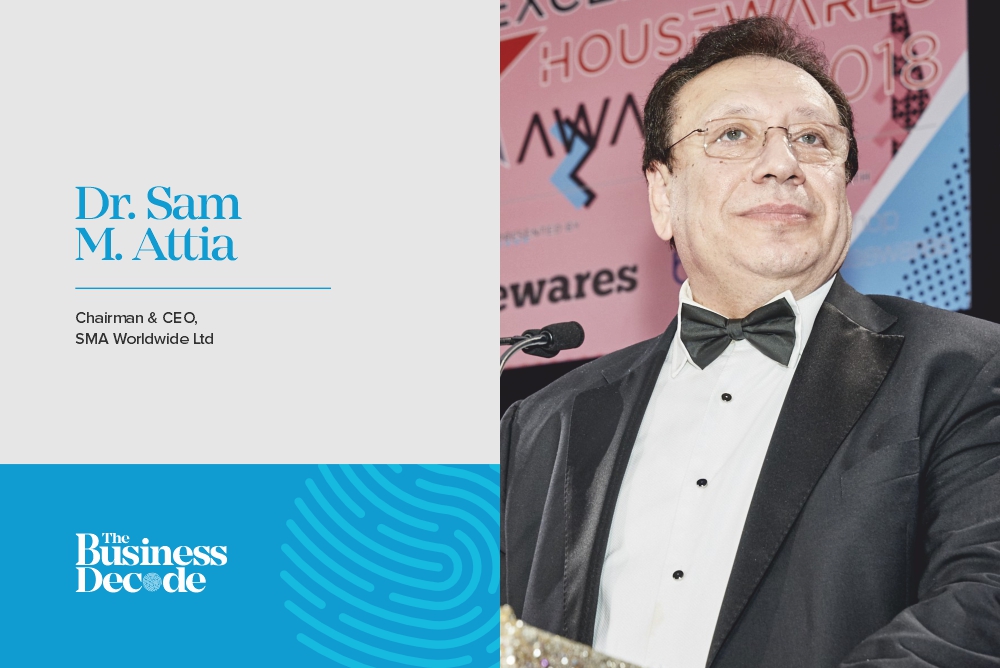
Dr. Sam M. Attia is Chairman & CEO of SMA Group, which includes enterprises in international logistics, SDA (Small Domestic Appliances) manufacturing and distribution, security, and strategic consultancy to major international blue-chip companies across six continents. In 2025 he started his own publishing company with books all under his name.
With a medical background, he achieved an MBA with distinction from Kingston University (UK) and a PhD (Summa cum laude) from Columbia (USA). He is a Fellow of the UK Insttue of Directors (FIoD) and a Certified Chartered Management Consultant (CCMC).
Over more than fifty years across business and medicine, Dr. Attia has developed a leadership philosophy grounded in diagnosis before action, coherence before scale, and legacy before applause. This philosophy shapes the way he leads organisations, evaluates risk, aligns people, and creates long-term value.
He is also the author of best selling SMA CODE©, SMA Vibes©, SMA GMD©, (on Amazon and more than 40+ e-commerce book shelves) and SMA Medicine Unboxed (out in May 2026) and is developing a wider codex of 30 books with his publishing company (smabooks.com) His aim is not simply to tell a personal story, but to preserve and transfer principles that help current and future entrepreneurs, startups, and leaders think more clearly, act more strategically, build enduring institutions, and ask better questions rather than accept easy answers. His latest book, Trumpology© is the most complete anatomy yet of how Trump was made and how he remade American power. It is a biography of systems, not just a man where Trump is explained through money, myth, war, and the collapse of restraint. It is the science of Donals’s psych.
Coherence and Long-Term Leadership
Dr. Attia describes his role as the father of the SMA family rather than simply a corporate leader. His vision is to build an organisation that can endure because it is coherent, where vision, people, values, systems, execution, and timing move in disciplined alignment. “Over more than fifty years in business and medicine, I’ve learned that sustainable success is rarely the result of one brilliant decision. It’s usually the outcome of consistent judgment repeated over time,” he reflects.
This philosophy has shaped SMA Group by prioritising reputation, trust, operational discipline, and strategic patience over speed or visibility. “I’ve never wanted SMA companies to be a company that reacts to every trend, but to become a business that understands what matters, moves with intention, and scales without losing its identity,” he explains. The same thinking informs his books SMA CODE©, SMA VIBES©, and SMA GMD©.
“Leadership must be codified if it is to be repeatable, teachable, and transferable across generations,” he affirms.
A defining lesson came when Dr. Attia realised that urgent movement is often mistaken for progress. “Never treat symptoms while ignoring the underlying condition,” he reflects. Since then, he’s tested major decisions through structural, human, and legacy impact. “Judgment is not about speed alone, but about seeing further than the immediate horizon and acting in a way that protects the future,” he concludes.
Forces Shaping the Next Decade
Dr. Attia believes that, over the next decade, four forces will shape the industries in which his companies operate, and perhaps any industry at all: intelligent automation and applied AI, real-time business intelligence, reputational trust, and resilience in a fragmented geopolitical and economic environment.
For him, the key is not technology itself but how leaders use it. “Technology can improve visibility, speed, forecasting, and precision, but it can’t replace human judgment, ethical discernment, or strategic timing,” he insists. He also cautions that automation without disciplined leadership can simply accelerate inefficiency. “Businesses that automate badly will only become inefficient at a higher speed. Businesses that combine technology with disciplined leadership will widen the gap between themselves and the rest of the market,” he observes.
Dr. Attia believes organisations that connect data with judgment, scale with culture, and innovate responsibly will succeed in the next decade. This led him to develop the Global Multi-Domestic Dynamic Model outlined in his book SMA GMD©. “Tomorrow markets and business will live in a totally different landscape and under totally different criteria than the status quo,” he predicts.
“Technology can accelerate decisions, but it cannot replace judgment.”
Innovation with Discipline
Dr. Attia treats innovation and stability as partners rather than opposites. “Leadership must protect the core while carefully testing the edge through considered risk-taking. Innovation without discipline becomes disruption for its own sake. Stability without innovation eventually becomes a slow decline,” he insists.
In practice, he evaluates innovation through three questions about real problems, long-term strength, and operational integration: “Does it solve a real problem. Does it strengthen our long-term position? Can it be integrated without weakening reliability, culture, or service quality?” When the answers are positive, ideas are piloted carefully, lessons are learned quickly, and successful initiatives are scaled responsibly, as seen in the award-winning SMART SDA products they develop and build.
Dr. Attia notes that leading a multinational organisation requires clear central standards while allowing local adaptation to prevent fragmentation. “Change must strengthen the entire system; the objective is not change for its own sake, but intelligent evolution,” he concludes.
Leading Through Alignment and Clarity
One of the most complex challenges is balancing growth, regional responsiveness, and cultural consistency, because without clear leadership, teams can move in different directions while believing they serve the same mission. “As organisations expand, complexity grows faster than most people realise,” Dr. Attia says.
Leadership is not only about setting vision but designing alignment through clear principles, disciplined communication, visible accountability, and trusted behavior. “Alignment does not happen by a memo,” he insists. Many organisational problems come from ambiguity rather than scale. When priorities and decision frameworks are clear, teams execute with greater focus and cohesion. “Complexity in business often comes from ambiguity, not scale,” he notes.
“After more than fifty years in business and medicine, I credit the people I’ve worked with for shaping these lessons. I learned more than I taught and cherished everyone I dealt with. They’re the reason for my success with them and others,” Dr. Attia reflects.
“After more than fifty years in business and medicine, I’ve learned that the real work of leadership is not control; it’s building teams, asking better questions, and developing coherent, dynamic models that are true to the environment you’re building your enterprise within.”
Technology as a Decision Amplifier
Dr. Attia integrates technology and business intelligence to create clarity, using tools to turn insight into faster, more precise action. “The real value of technology is not the tool itself, but the quality of clarity it creates,” he notes. At SMA, digital tools enhance visibility, reporting, forecasting, and operational coordination, while intelligence comes from interpreting data and acting with sound judgment. “Data on its own is not intelligence. Intelligence begins when information is interpreted in context and converted into action,” he explains.
One example is the SMART Egg boiler, which uses AI to alert users when eggs reach soft, medium, or hard consistency, delivering precise results for a simple everyday task. “We used chip AI technology to solve a very basic problem of not knowing how to get your perfect egg in the morning,” he notes.
For Dr. Attia, business intelligence must support strategy and execution while staying human-centered. Numbers inform decisions, but effective leadership relies on judgment, experience, and understanding of people. “Numbers do not manage organisations. Leaders do,” he observes. He believes the future will reward leaders who combine technological literacy with ethical, strategic, and human judgment.
“Zoom and TEAM connect computers; only human physical meetings can produce great ideas.”
Clarity Through Disciplined Habits
Dr. Attia believes leadership clarity does not happen accidentally, but comes from disciplined habits – protecting time for reflection, reading, structured thinking, and note-taking to avoid reactive decisions under pressure.
A routine that has guided him for decades is writing, capturing observations, patterns, lessons, and questions. His books, including the upcoming Trumpology© and SMA Medicine Unboxed©, grew from this long practice of reflection. “I capture observations, patterns, lessons, and questions continuously,” he shares.
He maintains perspective by regularly stepping back to ask what truly matters, what is noise, what signals or risks are emerging, which principles must be protected, and what needs to change. “Those questions preserve focus and keep me anchored in substance rather than distraction,” he notes.
From Business Activity to Institution
Dr. Attia sees a defining milestone in SMA’s evolution as the point when the company began operating not just as a business but as an institution with a long, diversified horizon, shifting focus from activity to identity guided by method, structure, and purpose. “Many companies can achieve activity. Fewer build a method. Even fewer build an identity that can scale without becoming diluted,” he says.
Under this approach, SMA expanded into international logistics, palletised operations, DG licensing from IATA, SMART manufacturing and distribution, Middle East security operations, and global consultancy across six continents. And now specilaised book publishing. For Dr. Attia, the milestone signified maturity rather than mere scale. “We were becoming clearer about what we should stand for, how we should lead, and how we should be recognised globally,” he explains.
This transition also shaped his thinking on legacy and knowledge transfer, shifting focus from growth alone to preserving the principles that made it possible. “If I’m building a real legacy beyond business, it will be my books,” he notes.
Alignment Across Regions Through Clarity
Dr. Attia believes regional alignment starts with clarity, emphasising mission, values, operating standards, KPIs, and decision principles in simple, memorable terms, with culture reflected in behaviour rather than words alone. “People cannot align with what has not been defined properly,” he says.
He stresses that leadership by example is critical, as they take their cues less from what is written and more from what is tolerated, rewarded, repeated, and modelled, with consistent behaviour preventing fragmentation and reinforcing shared standards across regions.
He emphasizes that alignment also requires ongoing dialogue, allowing local adaptation within shared purpose and principles to achieve unity without uniformity. “Alignment is not uniformity. The balance is local intelligence with strategic unity,” he observes.
“Growth becomes dangerous when it outruns culture, governance, and clarity.”
Preparedness Over Prediction
Dr. Attia argues that competitiveness in a volatile global economy depends on preparedness rather than prediction, enabling organisations to absorb shocks, detect change early, and respond with discipline while staying close to markets, strengthening decisions, protecting credibility, and maintaining strategic agility. “Competitiveness begins with preparedness, not prediction,” he says.
He sees resilience as multi-dimensional, encompassing operational discipline, financial prudence, diversified relationships, robust intelligence flows, and a culture that stays calm under pressure, while leaders must think in scenarios and develop capabilities that endure across multiple possible futures. “The future is too fluid for rigid thinking,” he explains.
Learning speed is critical, as organisations fail not from lack of talent but from slow adaptation. He emphasises observation, analysis, adaptation, and honest internal dialogue across teams, which he regards as an extended family. “Durability comes from disciplined preparedness,” he notes.
Partnerships as Accelerators of Growth
Dr. Attia sees global partnerships and cross-border collaborations as accelerators of intelligent growth, expanding perspective, deepening market understanding, strengthening capability, and creating opportunities that would take far longer to achieve alone. “No organisation can see clearly from a single vantage point,” he notes.
He values partnerships grounded in credibility, strategic alignment, and mutual respect. “Strong businesses use partnerships to multiply their strengths. The right collaboration builds trust, shortens learning curves, leverages complementary strengths, and tests the organisation’s coherence,” he explains.
Cross-border engagement sharpens leadership by revealing assumptions and demanding higher standards of communication and preparation. “True progress comes from cooperation, not protectionism. Synergy is only created from real cooperation and value-added coherence,” he notes. For SMA, partnerships go beyond transactions; they help the organisation stay relevant, connected, and forward-looking in a highly interdependent world.
Guiding Principles for Enduring Leadership
Dr. Attia’s advice to aspiring CEOs: don’t confuse ambition with capability, as capability allows others to rise with you; think in decades rather than quarters to build enduring institutions; study systems, people, and consequences, ensuring diagnosis precedes intervention and human factors guide performance; be bold and take clear positions when necessary, such as advocating for physical collaboration over purely digital work; and codify thinking through writing so principles are articulated, preserved, and transferable beyond individual careers.
Dr. Attia aims to influence future leaders first by example, showing they can combine ambition with discipline, grow responsibly, and lead strategically while staying connected to people; and second, through codification, as experience gains value when turned into frameworks and principles others can use.
He sees his books as an extension of his leadership legacy, documenting his experience so others can challenge, refine, and apply it. His trilogy captures leadership discipline, human dynamics, and a global model for future markets, forming part of a wider 30-book codex to preserve lessons from decades of practice. His latest book, Trumpology© is a bold analysis of the complex structure President Trump was made of and the 240+ pages addresses the why and more importantly the “what next” with this unique 45th and 47th president of the USA.
Dr. Attia views writing as a discipline that clarifies thinking and turns experience into principles that future leaders can apply. His goal is practical impact, not personal recognition. “I hope my journey demonstrates the value of building substance first. If younger leaders can think more clearly and build more enduring organisations because of what I’ve written, that’ll be one of the most meaningful forms of impact I could leave behind,” he reflects.
“I am writing not to describe my journey, but to preserve the principles that helped shape it.”
Conclusion
Dr. Attia’s leadership philosophy underscores that lasting impact comes from building capable teams, thinking long-term, studying systems and people, and codifying experience into transferable principles. For him, the real work of leadership is not about control; it is about building teams, asking better questions, and creating coherent, dynamic models that align with the environment in which the enterprise operates.